
Ghostly Waters | David Vélez
Gruen 231 | Postcard (+ Digital & Bandcamp code) | Digital > [order]
Reviews
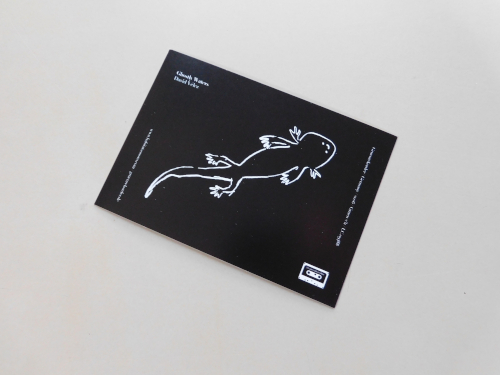
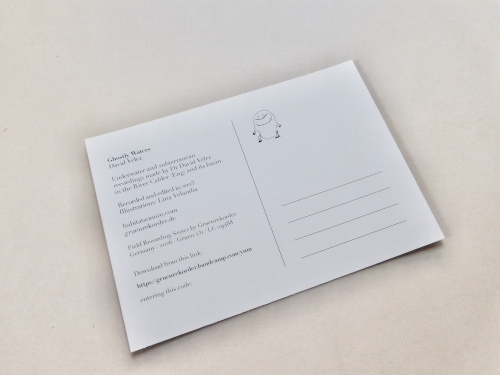
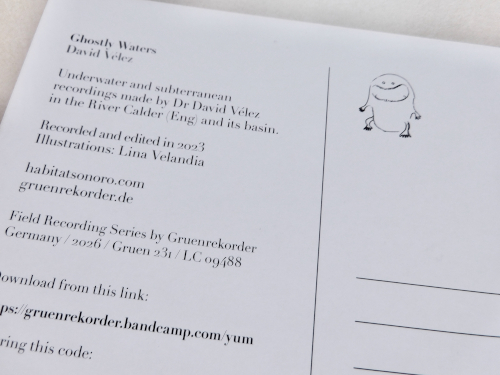
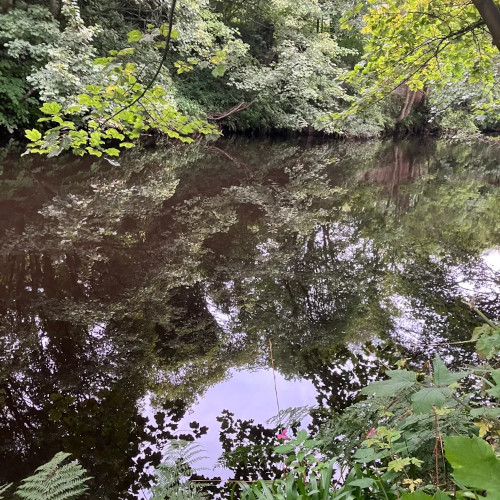
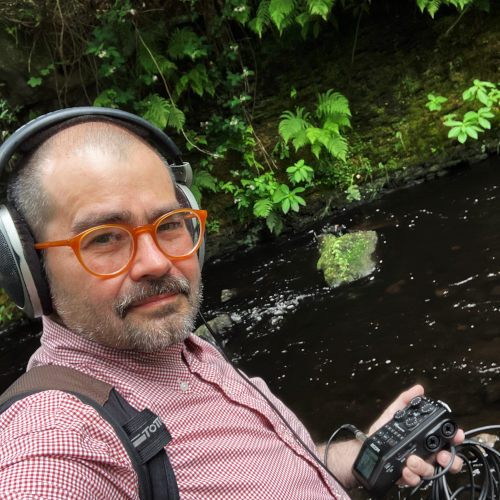
Between July and August 2023, I made an extensive series of underwater and subterranean recordings in the River Calder and its basin, across the towns of Warley and Norland in Calderdale, England.
About the River Calder
The River Calder is the main water source for farms in the Calderdale and Kirklees boroughs, thanks to its richness in calcium and magnesium carbonate, formed hundreds of metres deep, 310 million years ago during the Carboniferous period. At that time, the Calder basin was home to an exuberant biodiversity comparable to the Amazon rainforest. Amphibians such as Microsauria, Eryops, Diplocaulus, Labyrinthodontia, and Nectridea thrived until the “rainforest collapse,” a drastic climate shift — including a 6 °C drop in temperature — that extinguished them and many other life forms. Today, the Calder suffers from uncontrolled sewage leaks, making it the second most polluted river in England, a product of careless practices from private water forms.
Recording and Editing Notes
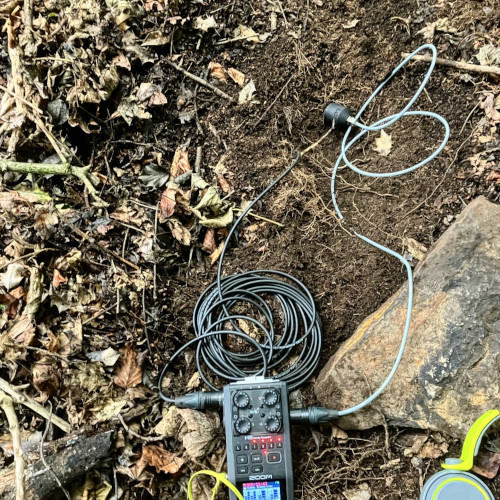
Using hydrophones and geophones, I documented the sounds of the river’s black-coloured water, soil, and boulders — a habitat shaped by dark minerals and organic residues as the Calder percolates through coal seams, carbonaceous shales, and ironstone. The river’s coarse, bubbling, gurgling, crumbling, tapping, scraping, and dripping sounds created a mysterious, ghostly aurality, perhaps linked to the density of the media through which sonic waves travel there, which to me echoed the river’s biological decay. Among the recorded sounds, some were particularly quirky and murky — a series of growling, expressive tones that intrigued me, as I could not identify their source. They may have been produced by fish feeding on algae, such as roaches or chubs, species especially vulnerable to contamination. Moreover, many of the recordings, especially those made underground, were so subtle that I had to set the recorder at a high level, resulting in a hiss. Friction against the hydrophone and geophone cables also introduced unwanted noise, both of which I embraced in the editing process to emphasise the pollution affecting the Calder. I then layered water, soil, and boulder sounds to create depth — drawing out enigmatic, ghostly resonances.
Reflections
The guttural sounds of roaches and chubs, the hiss, and the ghostly elements I hear in the Calder link its past and present, serving as a reminder of the environmental changes that have occurred since the era of the great amphibians of the Carboniferous. In this sense, these recordings stand as a call to defend our rivers and their inhabitants from the pollution born of private irresponsibility — to decelerate the imminent extinction of the human species and to leave future inhabitants species of the Earth a healthier ecosystem.
Illustrations
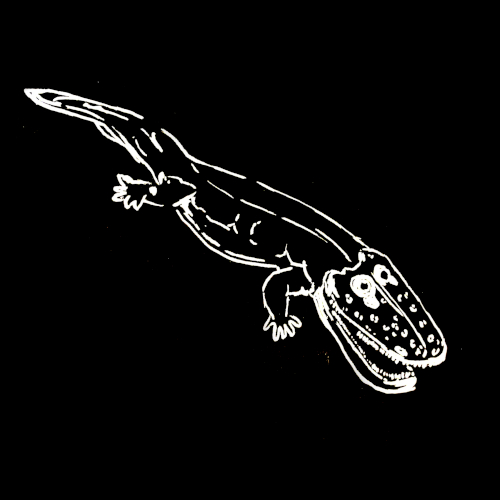
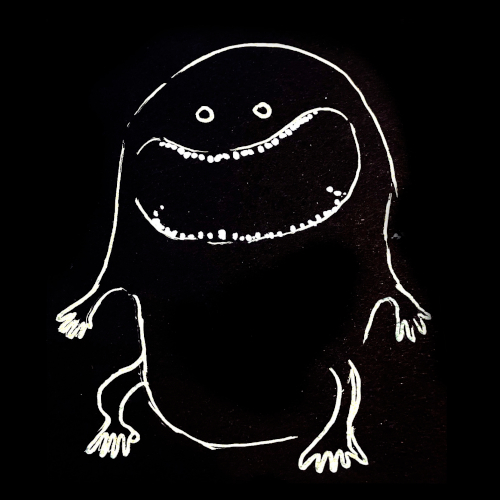
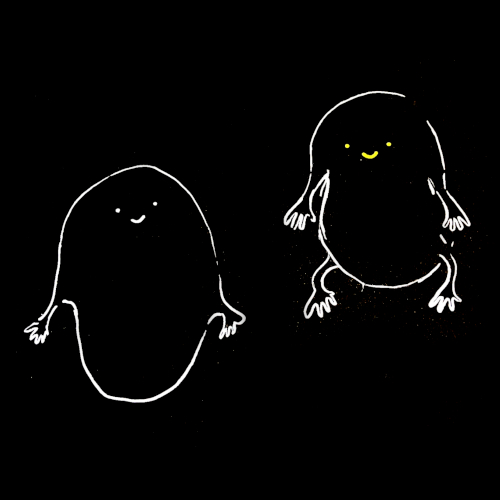
To accompany the recordings, artist and illustrator Lina Velandia created a series of drawings evoking giant amphibian ghosts from the Carboniferous era, product of her experience listening to the recordings.
Lina is a Colombian visual artist based in the UK, whose work operates at the intersection of cartoon aesthetics, pop culture, and neo-expressionism. Through spontaneous, character-driven drawings and a vivid use of colour, she explores themes of feminism, migration, well-being, and precarity, engaging questions of identity and vulnerability.
@todoloquesemuevesuena
Notes
Ghostly Waters is the fourth part of a series of artworks created using this group of recordings from the River Calder, together with the installations:
The River Within (The Urban Nature Sonic Pavillion/SAIC) Chicago, US 2024
The Calder in your Guts (Sounds of Dissent/DCI) Dublin, Ireland 2024
The Calder in your Bones (HCMF/Cultures of sound) Huddersfield, UK 2023
1. Ghostly Waters
1 Track (70′18″)
Postcards (500 copies)
Audio Mastering: Bruno Duplant
Special thanks to: Lasse-Marc Riek, Roland Etzin, Lina Velandia, Bruno Duplant, Jelena Gligorijevic, University of Huddersfield, Cultures of Sound, Dublin City University, SAIC, Experimental Sound Studio in Chicago, HCMF, and Ruchi Singh.
Underwater and subterranean recordings made by Dr David Vélez in the River Calder and its basin, across the towns of Warley and Norland in Calderdale. Recorded and edited by D. Vélez in 2023, in Northern England
Illustrations: Lina Velandia
habitatsonoro.com
Field Recording Series by Gruenrekorder
Germany / 2026 / Gruen 231 / LC 09488
Richard Allen | a closer listen
David Vélez ~ The River Calder
After seeing the illustration of a cute but anguished monster, one wants to know more. Lina Velandia‘s line drawings grace the release by David Vélez, an original way to draw us into the story of the River Calder. Two months of recordings have produced three international installations to date, and now these sounds appear on a physical release.
The story begins 310 million years ago during the Carboniferous period, as the River Calder was formed. Home to “amphibians such as Microsauria, Eryops, Diplocaulus, Labyrinthodontia, and Nectridea,” the basin was a hotbed of biodiversity until a “rainforest collapse” marked by a six-degree temperature drop wiped out most of its thriving population.
Enter now the “ghostly elements” of the river, as captured by Vélez, and the “giant amphibian ghosts” drawn by Velandia. These creatures communicate now through the Ghostly Water. The backdrop is black, a reflection of the environment: “black water, black soil, black boulders,” the product of carbon, coal and iron. Less than a minute in, and already some strange creature is grinding, either a living creature or a fossilized remnant begging to be heard. The white noise behind the drip and flow is similar to that heard in hauntology. But why would the ghosts of the past seek to communicate with us today? Is it simply because their lives were cut short by the rainforest collapse? No, because the area eventually recovered, becoming the main source of water for a series of surrounding farms, only to be devastated once more by a series of sewage leaks. In a short period of time, millennia of progress were dissolved.
Look again at the creature on the cover. That is the face of one powerless to protect its own environment, its loved ones, its life. The creature may have been frozen in mid-grimace, its soul locked into the coal. Vélez’s murk and hiss are intentional representations of pollution and decay. The irony is that life continues to proliferate, even in these circumstances. One can hear the residents crunching, mating, conversing, and making a hydrophonic racket, amplified with studio treatments. But the more Vélez records, the more he hears ghosts: ghosts of warning, ghosts of dismay, ghosts who have been through this before and never thought they would go through this again. They call to us from the past, these “giant amphibian ghosts,” perhaps threatening to rise again, to enact revenge on behalf of their besieged descendants.
At times during the 70-minute recording the sounds of these creatures fall quiet, perhaps the result of a poisoned feeding, or in a more innocuous fashion, a nap. And all the time, the river continues to flow, just as time continues to flow, carrying all in its wake. Compared to the species who live in the river, humans have been around only a very short time. In one form or another, the river may outlast us. But we can still – and have – done irreparable damage in our short span. At one point, the biophony was said to be akin to that of the Amazon rainforest; now it is thin and divided. The listener is able to hear every individual creature: roach, chub, cricket, fish. The biophony is active, always in flux, switching characters every few minutes; but it is not as lush as it was before. One would not want to dip even a toe in this sewage-addled water, yet somehow there is life.
After a series of tiptoe sounds, an audible shift occurs in the 41st minute. Suddenly the sonic field increases in density; deeper, hollowed-out, like manhole covers dragged across asphalt. Are these the sounds of recovery or demise? In this segment, the boulders, the sediment, the rocks begin to speak, bringing to mind the prophecy, “the stones will cry out.” All of nature seems to be in total agreement – sadly, all except us.
link
ROMBO Editorial Staff | Rombo Magazine
David Vélez’s ‘The River Calder’ Gives Voice to an Ancient, Polluted Watershed
Colombian sound artist David Vélez spent two months recording England’s River Calder, translating 310 million years of ecological memory—from Carboniferous collapse to modern sewage leaks—into a 70-minute physical release.
David Vélez’s new release does not celebrate the River Calder. It listens to what the water has absorbed: the grind of fossilized remnants, the hiss of coal-dark silt, and the spectral warnings of amphibian life that once thrived here. Built from two months of field recordings—already installed in three international spaces—the work now arrives as a physical document, its cover graced with Lina Velandia’s line drawings of grimacing, powerless creatures.
The story starts 310 million years ago, during the Carboniferous period, when the river basin churned with biodiversity. A rainforest collapse, triggered by a six-degree temperature drop, then erased most of that life. Much later, agricultural runoff and sewage leaks did their own damage. Vélez treats both disruptions as audible layers, threading ancient trauma with present decay. White noise smears behind insectile clicks and the constant drip of water; a grinding sound emerges within the first minute, part organism
link
Rigobert Dittmann | Bad Alchemy Magazin (133)
DAVID VÉLEZ nimmt mit Ghostly Waters (Gruen 231, DL + Postcards) mit zum River Cal- der, bei Warley und Norland im Distrikt Calderdale in West Yorkshire, England. Der 1973 in Bogotá geborene Sound Artist mit einem PhD in Sonic Art and Music Technology an der University of Huddersfield nähert sich dabei über ein bloß phänomenologisches Hören hinaus mit einer ‚taktilen Musik‘ aus hydro- und geophonen Aufnahmen quasi diagnostisch an. Denn dass der Calder durch die einstigen Textilfärbereien, eine stillgelegte Teerbren- nerei und unkontrollierte Abwässereinleitungen der am zweitstärksten verschmutzte Fluss Englands ist, das hört man nicht. Ebensowenig den Reichtum an Kalzium- und Magnesiumkarbonat im Fluss und im landwirtschaftlich genutzten Flusstal. Als Relikt aus dem Karbon vor über 310 Millionen Jahren, als die Gegend – der am Äquator gelegene avalonische Teil von Laurussia/Euramerika – ein tropischer Regenwald gewesen ist voller Megafauna. Die Postkarten, gezeichnet von Lina Velandia, die seit Jahren die Klangkunst von Vélez illustriert, zeigen riesenamphibische Geister dieser Vergangenheit. Eine Ver- gangenheit, die im Calder weiter blubbert, gurgelt, kratzt, knistert und durch Kohle- und Schieferschichten sein Wasser schwärzt. So wie seine Verunreinigung die Hi-Fidelity ‚verschmutzt‘. Doch was da im Unklaren im und um den Fluss herum geisterhaft fließt, lispelt, gurgelt, rauscht, schabt, quakt und dumpft – Döbel, Rotaugen…, Schaben…, das Wasser, die Zeit und ihr anthropozäner, biophob und giftig gewordener Zahn – all das mahnt, das Werk der ahumanen, der klimatischen und geologischen Kräfte nicht durch kurzsichtigen Eigennutz zu verschlimmern. Sondern auf Stimmen zu hören wie dem Ento- mologen und Half-Earth-Ratgeber E. O. Wilson, Michael Marder mit seinem ‚Plant-Thin- king‘, Jeffrey T. Nealon mit seiner ‚Plant-Theory‘. Und auf das, was die Natur mit ihrem Jahrmillionen alten Gedächtnis ‚flüstert‘. Um daraus Konsequenzen zu ziehen.