
Kozmické louky | Magdaléna Manderlová
Gruen 230 | Vinyl (+ Digital) | Digital > [order]
Reviews
Ale slyším zpěv ptáků.
Tak přesný,
tak krásný,
až to vypadá,
že se nic nezměnilo.
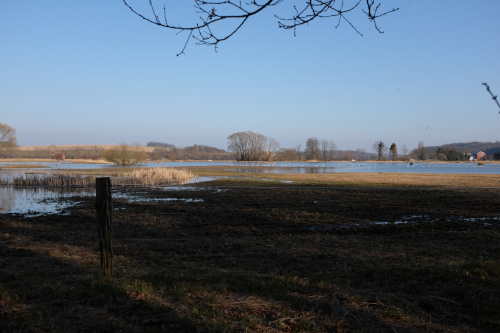
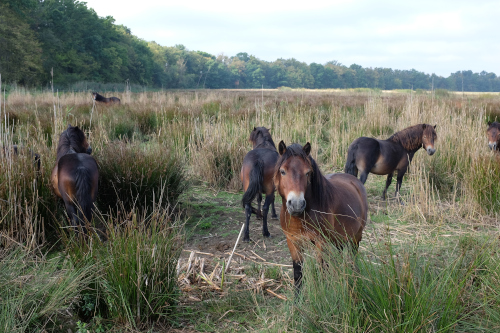
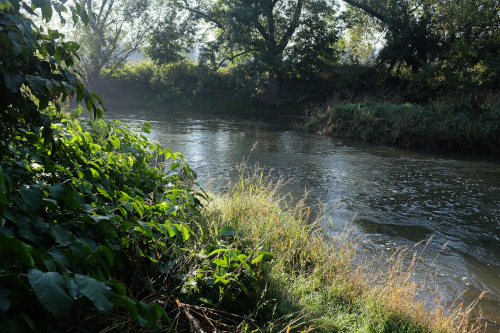
Kozmické louky is a wetland in Silesia, on the very edge of the Czech Republic bordering Poland, where I come from, and one of the last two remaining floodplain areas on the Opava River, locally known as the Opavice. Thanks to ongoing restoration, this system of alluvial meadows has once again become home to multitudes of animal and plant communities, while at the same time facing the local-global climate crises. The album Kozmické louky listens closely to this environment and its changes over time, entering into a dialogue with it, imagining and dreaming through field recordings and electroacoustic compositions created on site or in close relation to it between 2021 and 2025.
There comes that rare moment when a human being falls silent. Alone, on behalf of their kind, which for a brief instant ceases to make sound. And in that silence —not empty, but vibrating — I begin to hear all the others. All the sounds not meant for me, yet surrounding me, including me, absorbing me. Breaths, rustles, songs, rhythms that form endlessly shifting compositions — an unceasing communication, voices attuned to themselves and to the environment that carries them. I sense that what I call “now” or “I” is only one of the knots in that vast network — a condensation of relations that both exceed me and bring me into being. It is a state of deep quiet, an almost meditative moment of bliss. As if, for an instant, a vision opened into a world that transcends us — a realm where all living beings breathe in mutual understanding, in delicate, enduring balance. It happened in Kozmické louky. A revelation of the senses, a seeing through layers. The soundscape has become music. It depends only on how sensitive we are towards the land, and how that music will be heard.
A
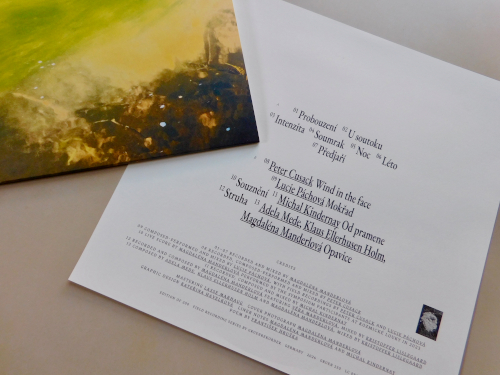
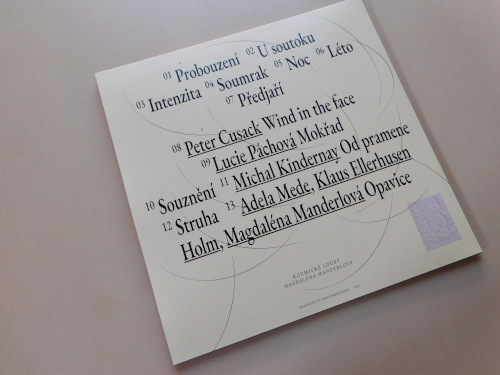
01 Probouzení
02 U soutoku | MP3
03 Intenzita
04 Soumrak | MP3
05 Noc
06 Léto
07 Předjaří | MP3
B
08 Peter Cusack – Wind in the face
09 Lucie Páchová – Mokřad
10 Souznění
11 Michal Kindernay – Od pramene
12 Struha
13 Adela Mede, Klaus Ellerhusen Holm, Magdaléna Manderlová – Opavice
13 Tracks (42′56″)
Vinyl (200 copies)
Credits
01-07 Recorded and mixed by Magdaléna Manderlová
08 Recorded, composed-performed and mixed by Peter Cusack
09 Composed-performed and mixed by Lucie Páchová, with field recordings by Peter Cusack and Lucie Páchová
10 Live score by Magdaléna Manderlová performed by the symposium participants at Kozmické louky in 2023
11 Recorded, composed and mixed by Michal Kindernay
12 Recorded and composed by Magdaléna Manderlová featuring Věra Manderlová, mixed by Kristoffer Lislegaard
13 Composed by Adela Mede, Klaus Ellerhusen Holm and Magdaléna Manderlová, mixed by Kristoffer Lislegaard
Mastering: Lasse Marhaug
Cover photograph: Magdaléna Manderlová
Graphic design: Kateřina Havelková
Liner notes: Magdaléna Manderlová and Michal Kindernay
Poem: František Hruška
Edition of 200
I warmly thank all the artists, scientists, local communities, and all living beings of Kozmické Meadows. Special thanks to Elin Már Øyen Vister, Frank Ekeberg, Jakub Frank, Martin Klimeš, Michal Kindernay, Roland Etzin and Lasse-Marc Riek, Ole-Tobias and Emilie, friends and family.
The album was created alongside the long-term project Kozmic Sounds by Magdaléna Manderlová and Michal Kindernay, initiated by Bludný kámen in 2021. In 2025, an autonomous listening station was placed in the meadows in collaboration with radio.earth and Udo Noll, listen here. In 2026, an extensive article about Kozmic Sounds was published by Journal of Sonic Studies, read here.
Field Recording Series by Gruenrekorder
Germany / 2026 / Gruen 230 / LC 09488
Richard Allen | a closer listen
The amazing Gruenrekorder label follows up last year’s Sounds of the Wetlands, one of our top field recording albums of 2025, with a pair of water-based releases. Kozmické louky is a further investigation of wetlands and their surrounding environments, while the extended work Ghostly Waters takes a deep dive into the River Calder and its rich biophony. We’ll be covering one today and the next one tomorrow.
Magdaléna Manderlová‘s Kozmické louky was recorded over the course of five years at the Polish border of the Czech Republic. Once endangered, this natural floodplain has begun to return to life; yet the larger crisis of climate change continues to threaten its stability. For now, the artist invites listeners to reflect on the intertwined lives of its inhabitants: creatures of water and air, an extensive biosystem dependent on the health of the wetlands.
“Probouzení” (“Awakening”) introduces us to these residents, who create a dense thicket of sound. In this piece, the traffic is also close enough to be heard, a constant reminder that even protected spaces have boundaries. In “U soutoku” (“At the Confluence”), one can hear human voices, though the flowing water is the main character. Birds galore dominate “Intenzita” (“Intensity”); the title is well-chosen. While it’s difficult to estimate by sound alone, there seem to be hundreds of birds, all communicating at once. If only this piece were a bit longer! In contrast, individual fowl are heard flapping their wings in the subsequent piece, along with a high-whistling creature whose cry is like that of air escaping from a balloon. “Léto” (“Summer”) introduces swarms of bees, who are both pollinators and food, nestled in the center of the food chain, while rain falls gently at the end of Side A, covering all with sweet white noise, only to be interrupted by a foreboding motor.
Of the Opava River wetlands Manderlová writes, “Breaths, rustles, songs, (and) rhythms … form endlessly shifting compositions.” On Side B, she extends the invitation to guest composers. Peter Cusack‘s “Wind in the Face” adds assertive notes to the watery backdrop, playing in tune with the wetland symphony. Church bells ring in Lucie Páchová’s “Mokřad,” adding a sense of holiness. In the center, human percussion is met by nature’s own pops and beats while in the distance, one can hear joyful human song. “Souznění” is an outlier: Manderlová’s score performed live by human participants, who imitate the sounds of nature in a convincing manner.
Michal Kindernay discovers a drone in the midst of the mix, and amplifies it with a corresponding drone of his own, which dissolves into the wetland flow. In the next piece, Manderlová engages in conversation with beloved relative Věra, and in the closing piece, she invites Adela Mede to form a human chorus while clarinetist-composer Klaus Ellerhusen Holm serenades the stream. Together, these pieces capture the Kozmické louky in a time of recovery, their tone reverent and celebratory. It’s wonderful to hear a success story; may such progress continue!
link
textura
I’ve not been to Kozmické louky and, to be frank, needed a map to familiarize myself with its location. Situated north-west of Ostrava, this prime bird-watching site is described by the Oslo-based and Czech-born visual-and-sound artist Magdaléna Manderlová (b. 1991) as “a wetland in Silesia, on the very edge of the Czech Republic bordering Poland … and one of the last two remaining floodplain areas on the Opava River, locally known as the Opavice.” A quick online photo scan of the locale shows flat, far-reaching vistas filled with wildlife, water, trees, and walking trails. Despite the omnipresent threat of climate crises to this environment, the area offers a safe and comfortable home to a variety of animal species.
Still, while I’ve not visited the site, Manderlová’s field recordings-based sound portraits make me feel like a guest welcomed into the setting and privileged to eavesdrop on the sounds of its places and people for forty-three immersive minutes. As I close my eyes, I imagine myself within the environment, breathing in its replenishing air and attending to the songs of its birds and the subtle vibrations of winds rustling through its grasses. As one finds in any physical place, the vast network of sound elements in play at any given moment is multitudinous. In Kozmické louky, a special universe opens up to those receptive enough to hear it and sensitive enough to appreciate it.
Created over a five-year span, the release (issued in 200 vinyl copies and as a download) presents artfully doctored field recordings and electroacoustic compositions by Manderlová, primarily, and a number of fellow sound artists. A graduate of Trondheim Academy of Fine Arts and University of Ostrava, she brings her passionate interest in ecology to work that’s often site-specific and fieldwork-based and assumes the form of sound installations, compositions, concerts, writings, and, as is the case here, sound documents. Appearing on the release are thirteen pieces that were either created on site or in close proximity to it. Whereas the first side presents seven settings credited exclusively to Manderlová, the second features pieces by her, Peter Cusack, Lucie Páchová, Michal Kindernay, and others.
A symphony of bird caws, chirps, and swoops flows through the opening “Probouzení,” though even the dense mass of creature sounds isn’t enough to prevent the faint hum of distant traffic from seeping into the mix. While an industrial thrum likewise remains audible during “U soutoku,” it’s easy to ignore it when the commingling of site-specific bird chatter, burbling water, and human voices engages the attention. Furious bird cries dominate “Intenzita” so completely, one could be forgiven for imagining it a soundtrack excerpt from Hitchock’s The Birds. They figure into “Soumrak” too, with in this case the arresting screech of one bird type and the high-pitched warblings and wailings of another competing for attention. After “Noc” shifts the focus to an unrelenting stream of frog-like croaks, “Léto” contrasts the natural sounds of bees and birds with the chug of a machine mechanism. Side A ends with the hum of a plane passing overheard while nature elements crackle below.
The album’s second half begins with Cusack’s “Wind in the face” and clangorous, dulcimer-like sonorities punctuating a restless mix of water, wind, and bird sounds. Its dulcimer thrum carries over into Páchová’s ever-mutating “Mokrad” but now blended with an agitated array of writhing creature noises, distant vocal sounds, and gamelan-styled tinklings. Manderlová works two pieces into the second half, the first, “Souznení,” a live piece realized by participants at a 2023 symposium who, it sounds like, generated sounds to simulate the Kozmické louky site, and the second, “Struha,” a water-drenched setting featuring Manderlová conversing with her grandmother Vera. The project concludes memorably with “Opavice,” a piece co-composed by Manderlová, Adela Mede, and Klaus Ellerhusen Holm. One easily surrenders to the beguiling sound of a woman’s voice as her four-note melodies rise and fall amidst the droning backdrop, the phantasmagoric collage transfixing in its effect.
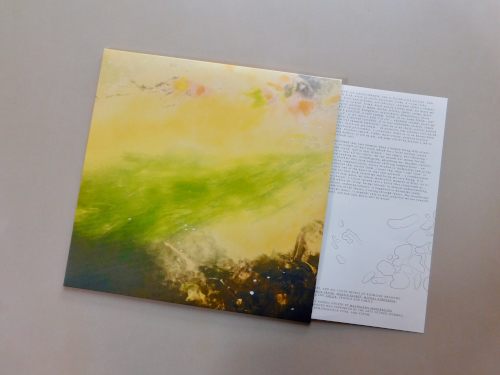
Manderlová’s visual abilities are well-accounted for in the colourful cover image, but it’s her gifts as a sound artist that are primarily showcased here and to compelling effect. Even if one, like me, hasn’t experienced the locale first-hand, her recording makes it possible to develop a clear and vivid impression of its character.
link
Holger Adam | skug – MUSIKKULTUR
Gruenrekorder Field-Recordings mal wieder. Hochempfindliche Spezialausrüstung, die in die Gegend gestellt und exakt ausgerichtet wird, um in quasi naturwissenschaftlicher Gründlichkeit zu dokumentieren, was sich akustisch so regt. Im vorliegenden Fall: vorwiegend Frösche, Vögel und Insekten, die durch Flora, Fauna und wechselndes Wetter hüpfen, staksen und krabbeln und dabei von feinen Antennen registriert werden. Wozu? An anderer Stelle und mit Augenmerk auf frühere Veröffentlichungen von Gruenrekorder sind mit solchen Aufnahmen verbundene Motive in den Blick geraten, die Soundforschung und -dokumentation, ganz allgemein gesprochen, als Kritik an einem anthropozentrischen Weltbild erscheinen lassen. Schon die behutsame Geste, ein Mikrofon auszurichten, um andere Spezies oder Naturphänomene zu belauschen, ist heikel genug (Obacht, wo man während des Aufstellens hintritt!) und will insofern als Ausdruck eines demütigen Verhältnisses zur Schöpfung verstanden sein. Das ist auch alles gut und richtig so, aber heute geht’s mir um einen anderen Aspekt. Über Aktivismus und Kritik hinaus: Worin kann der Gebrauchswert solcher Arbeiten noch liegen? Die Aufnahmen von Magdaléna Manderlová werden als Schallplatte mit impressionistischer Covergestaltung präsentiert und die dokumentierten Naturgeräusche als wohlklingende Kompositionen der mehr oder minder absichtslosen Wahrnehmung überlassen. Das Quaken, Piepsen, Plätschern und Knistern kann auf diese Weise eine beruhigende Wirkung entfalten und Menschen, die sich zur Entspannung von ASMR-Videos einlullen lassen, könnten zum Erreichen innerer Ausgeglichenheit ebenso zur Schallplatte mit Field-Recordings greifen. Die hat allerdings den Nachteil, dass man sich alle zwanzig Minuten wieder aus dem Ohrensessel erheben muss, um die Nadel aus der Auslaufrille zu nehmen und die Schallplatte zu wenden, um die Klangtraumreise fortzusetzen zu können, aber so erhält sich wenigstens eine minimale Aufmerksamkeit, die vor zu viel Dösigkeit schützt. Die Aufnahmen wollen ja gehört werden! Hört man zu, so wird man auf »Kozmické louky« auch des Umstands gewahr, dass sich unter die Naturgeräusche zum Ende hin zusätzliche Musikinstrumente und menschliche Stimmen mischen. Vorsichtig ergänzt Manderlová, was die Umgebung ihr an Material liefert, und in der Folge tritt der klangschöne und auch romantische Charakter der gesamten Aufnahmen mehr und mehr in den Vordergrund. Die Natur als Abstandsphänomen, in der philosophischen Anthropologie spricht man von »exzentrischer Positionalität«, regt die Sehnsucht an, in ihr aufgehoben zu sein. Musizierend und singend nähert sich Manderlová wieder an und für den Augenblick der aktiven Teilnahme (auch in der Rolle der Zuhörenden) mag die Grenze zur umgebenden Flora und Fauna verschwimmen oder gar momentweise aufgelöst werden. Dieser wunde Punkt markiert jedoch ebenfalls die gefährliche Grenze zu folkloristischem Kitsch und ideologischem Wahn. Ersteres ist nicht so schlimm. Hin und wieder soll man ruhig die Natur besuchen dürfen, wie das Paradies, aus dem man sich vertrieben wähnt, aber bitte im Bewusstsein, dass es kein Zurück gibt. Es wird also doch wieder kritisch. Field-Recordings against fascism! Ich nehme an, es gibt in der Community bereits entsprechend politisch informierte Diskurse um Wohl und Wehe der Inszenierung von Natur. Man kommt nämlich nicht drum herum: Die ästhetische Erfahrung von Natur hat als Modus der Bewältigung der Trennung ebendiese als notwendige Voraussetzung. Ästhetische Theorie, Grundseminar. Einfach gesagt: Die Komponistin kann als Arrangeurin dessen, was ihr als Natur erscheint, nicht aus ihrer Haut. Gut so.
link
Rigobert Dittmann | Bad Alchemy Magazin (133)
Kozmické louky (Gruen 230, LP), das sind die Vogelwiesen von Kozmice, ein renaturiertes Feuchtgebiet in Mährisch- Schlesien, nahe der polnischen Grenze. MAGDALÉNA MAN- DERLOVÁ stammt daher, hat jedoch ihr Studium nach dem Master in Ostrava in Trondheim fortgesetzt und lebt nun in Oslo. Sie schuf mit ‚Leangenbukta‘ und ‚In a Salty Stream‘ Sound Art aus vogeligen Klangwelten bei Trondheim und bei Castro Marim in Portugal, und war für ‚The Field upon which I Walk is the Song‘ inspiriert durch John Bergers Essay „The Field“. Auch diese LP führt in den Lebensraum von Piepmät- zen und Schreihälsen, im Vorfrühling und Sommer, in der Morgendämmerung oder bei Nacht. Mit Schnabelquak von Enten und Flügelschlag von Gänsen, von Ferne bellt ein Hund. Frösche quarren und keckern in geilen Massen, plumpsen ins Wasser. Insekten summen, Gefiedertes kräht und piepst poly- glott, sogar ein Kuckuck ruft. Wobei Manderlová das verdich- tet und mischt, einen in leisem Frühlingsregen stehen lässt, und ein Zug vorüberdopplert. Gefolgt von Peter Cusack mit vibrierend geharftem Draht bei ‚Wind in the face‘. Aus dessen Feldaufnahmen, Tierstimmen, Glockenläuten und glockigem Dingdong formte Lucie Páchová dann ‚Mokřad‘. Bei ‚Souznění‘ lässt Manderlová einen Chor aus Lippen-, Zungen-, Gaumen- lauten, Pfeifen und Summen erklingen, bei ‚Struha‘ geht sie mit ihrer Mutter (?) plaudernd einen rauschenden Bach entlang. Michal Kindernay lässt bei ‚Od pramene‘ ebenfalls Wasser gluckern, dröhnen, rauschen und verbindet das, wenn ich recht höre, mit dem choralen Singsang. Und bei ‚Opavice‘ (= Goldoppa) rauscht dieser einstige kleine Grenzfluss zwischen Preußen und Österreich zu einem von Manderlová mit Adela Mede angestimmten melancholischen Lied.
framework radio | #972
phonography / field recording; contextual and decontextualized sound activity
presented by patrick mcginley
Kozmické louky | Magdaléna Manderlová
The Best Field Recordings on Bandcamp | By Matthew Blackwell / April 2026
Kozmické louky | Magdaléna Manderlová
Kozmické louky, or “cosmic meadows” in Czech, is one of two remaining floodplains on the Opava River on the border of the Czech Republic and Poland. It’s the focus of recent restoration efforts and a new home for increasing numbers of birds and other animals. Magdaléna Manderlová spent four years engaging with the area, watching it develop, listening to it, and forming a dialogue with it. On Kozmické louky, Manderlová showcases the area’s newfound vibrancy with seven tracks of pure field recordings and then invites friends to experience it: field recordists Peter Cusack, Lucie Páchová, and Michael Kindernay each highlight different aspects of the meadowland. The album ends with a composition performed by singer Adele Mede and reed player Klaus Ellerhusen Holm, a lovely lilting melody over the gently murmuring waters of the floodplain. It’s a small detail, but after decades of drainage, filling, and plowing, it’s a joyous sound and rightfully highlighted in this celebration of revitalization.
link